
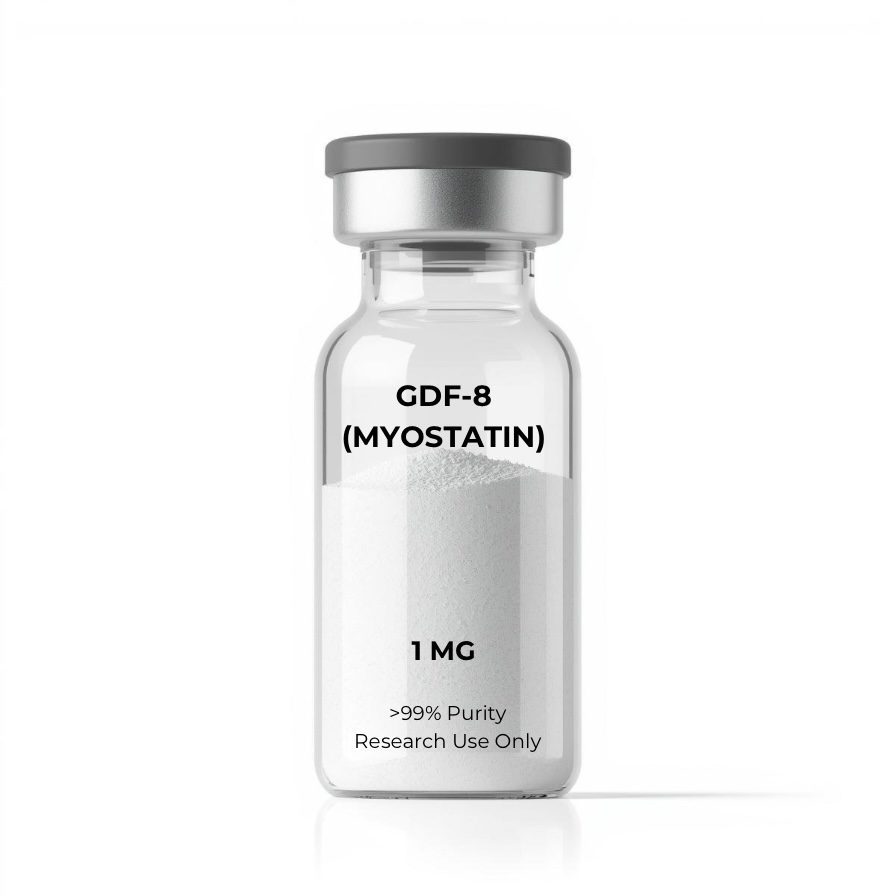
What is GDF-8 (Myostatin)??
GDF-8 (Growth Differentiation Factor 8, also known as Myostatin / MSTN, CAS 57103-13-4) is a member of the TGF-beta superfamily expressed specifically in developing and adult skeletal muscle. The bioactive form is a disulfide-linked homodimer (mature C-terminal domain, Asp268-Ser376) with an apparent MW of approximately 25 kDa. GDF-8 is the most potent endogenous negative regulator of skeletal muscle mass – signalling through ACVR2B/ActRIIB and ALK4/5 receptors to activate SMAD2/3 transcription factors, suppressing protein synthesis and promoting muscle atrophy. Loss-of-function mutations cause dramatic muscle hypertrophy across mammals (Belgian Blue cattle, whippet dogs, rare human cases). Recombinant GDF-8 enables positive-control muscle inhibition assays, inhibitor/neutraliser screening (ACE-031, follistatin, anti-MSTN antibodies), and mechanistic TGF-beta pathway dissection.
Research Applications
Muscle Inhibition Positive Control
SMAD2/3 signalling activation, myoblast differentiation inhibition, atrophy gene expression – positive control for myostatin inhibitor screening
Receptor Binding & Signalling
ACVR2B/ALK4/5 complex formation, SMAD2/3 phosphorylation kinetics, receptor selectivity vs. GDF-11, activins, BMPs
Inhibitor Screening Assays
Neutralisation potency of ACE-031, follistatin, anti-MSTN antibodies, SMAD pathway antagonists – ED50 determination
Muscle Wasting Models
Cachexia, sarcopenia, denervation atrophy – exogenous GDF-8 dose-response to establish atrophy gradient
Bone & Adipose Cross-Talk
Myostatin effects on osteoprogenitor differentiation, bone density, adipogenesis – body composition multi-tissue studies
Quick Specs
| Form | Lyophilized powder |
| Purity | >=99% by HPLC – every batch |
| CAS Number | 57103-13-4 |
| Molecular Weight | MS molecular weight confirmed – every batch |
| Specification | >=99% by HPLC – every batch |
| Shelf Life | 24 months unopened |
| Storage | -20C sealed | 2-8C reconstituted (use within 2 weeks) |
| Manufacture | In-house Fmoc SPPS – Qingdao, China |
| Brand | Asia |